Use Desktop for Better Experience
Frozen Motion and Intellectual Eccentricity in Kanō Sansetsu’s Old Plum
The Metropolitan Museum of Art, “Old Plum,” The Met Collection (Object No.1975.268.48a–d)
SOCIAL
Ryan Cheng
5/17/20267 min read
By shifting from the Momoyama period (1573–1615) to the Edo period (1615–1868), changes occurred not only in who held power in Japan but also in how art was used within elite spaces. Inside castles, palaces, and major institutions during the early Tokugawa era, status and authority were made visible with the help of large decorative paintings. In this world, a key role was played by the Kanō School.
Tied to the shogunal government, this long-lasting and unusually effective institution is described by Timon Screech as an official style capable of filling important rooms with images that looked unmistakably ‘Kano.’ Remaining a major center for courtly culture and temple patronage simultaneously was Kyoto. Associated with Kanō Sanraku and his successors, a strong Kyoto presence—often called the ‘Kyō-gano’ (Kyoto Kanō)—was also maintained by the Kanō.
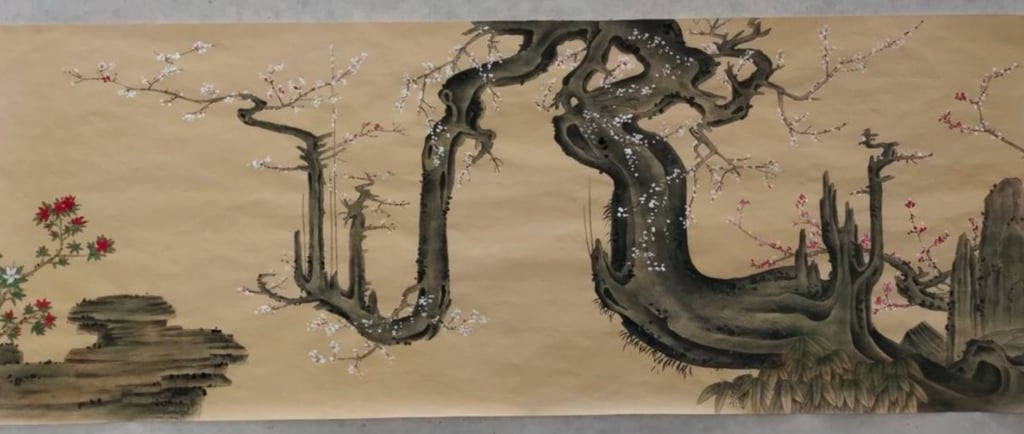
For a Kyoto Zen-temple context (Myōshinji’s Tenshōin) in 1646, Old Plum (Rōbai-zu fusuma, 老梅図襖) was painted by Kanō Sansetsu (1590–1651), who was linked to this Kyoto Kanō world. Depicting the Chinese theme of the Eight Daoist Immortals (Baxian, 八仙), the reverse sides of the panels are noted by The Metropolitan Museum of Art (The Met).
Because it suggests Old Plum was part of a planned room scheme rather than a stand-alone ‘flower painting,’ that detail matters significantly.
That Old Plum is both highly stylized and carefully planned is the argument of this essay. Depending on three connected things, its meaning emerges from: (1) the fusuma format—sliding doors making you experience the image through movement and partial views; (2) the way the plum motif is turned by Sansetsu from an intimate “poetic” subject into a bold, gold-leaf wall-size image; and (3) the pairing of the work with Chinese-themed imagery (the Eight Immortals) on the reverse. To describe how the tree looks like it is twisting and straining yet is pinned flat against gold, ‘Frozen Motion’ is used. Naming Sansetsu’s meaningful deviation within a highly codified Kanō system is done using ‘Intellectual Eccentricity’.
Fusuma Viewing: Image as Architecture
Identified as four fusuma panels (sliding doors) in ink, color, gold, and gold leaf on paper by The Met, Old Plum is noted to be viewed from right to left. More than just museum facts are represented by these details. Sliding on runners and functioning as doors, fusuma are a format explained by Screech as standardized architectural surfaces used to divide and connect rooms. Meaning that a fusuma painting is not meant to be read from one fixed spot like a hanging scroll, this format dictates a different approach. Approaching it, passing it, turning, sitting, and often seeing it in fragments, you are meant to live with it. Fitting early modern conventions perfectly is the right-to-left order. Stressing that precedence in paired formats commonly belongs to the right side, Screech connects the viewing order to right-to-left movement found in established display habits (including the direction of writing). Working in time, therefore, Old Plum unfolds as you move alongside it rather than simply being “there.”
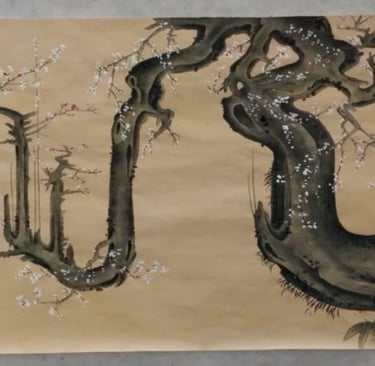
Physically interrupted by seams and hardware because it is split across several doors, Old Plum features a composition where those interruptions shape how the image reads. Broken by panel joins that make your eye pause and restart, the trunk fails to glide smoothly across a continuous surface. Reminding you that the “gold” is a built surface, the gold-leaf ground can also show the edges where sheets of leaf meet at close range. Reinforcing the same effect together, the seams and the gold leaf make the tree’s energy feel intense—twisting and straining—while it is also held in place, pressed against the room’s wall-like plane. Suggesting movement without releasing that movement into deep space, the painting offers a practical way to understand frozen motion; instead, by walking and seeing the image section by section, the viewer is made to supply the “motion”.
From Poetic Motif to Gold-Ground “Environment”
Originally a fan and now mounted as an album leaf, Ma Yuan’s Southern Song Viewing Plum Blossoms by Moonlight (early 13th century) serves as a useful comparison. Described by The Met as compact and poem-like, its atmosphere and restraint would be suited to close viewing. Coming nearly to the exact reverse is Sansetsu’s Old Plum. Taking a seasonal subject, it blows it up to an architectural scale. No longer is the plum an intimate scene. Set against a wide gold field with a dark trunk and branches, the plum becomes an environment inside the room.
Representing not only a difference in size, this reversal is also a change in how pictorial space is produced and consumed. Depending on close looking in Ma Yuan’s album-leaf format, “atmosphere and restraint” are created by ink tones, spare marks, and open paper forming a sense of night air; like a short poem unfolding in the imagination, the viewer mentally completes this. With a materially assertive ground, Sansetsu replaces that invitational emptiness. Reflecting ambient light and insisting on surface, gold leaf does not recede like mist or moonlight, thereby turning what might have been negative space into a luminous field that occupies the room. Shifting from a private, contemplative image held in the hands and read slowly, the plum motif consequently becomes an architectural presence that confronts the viewer at body scale. Carrying meaning more directly and forcefully once it operates as an environment rather than a vignette, the motif makes the plum’s seasonal and symbolic associations feel like part of the room’s program rather than an optional poetic aside.
Described through the discussion of auspicious imagery conducted by Screech is the reason why the plum was not just beautiful. Connecting the plum to the season of the lunar New Year, he notes the charged contrast of blossoms appearing on old, gnarled trees—where age is visible, renewal shows itself most clearly. Sansetsu’s emphasis is clarified by that context. Appearing to be weighty, aged, and strained, the trunk's appearance is precisely why the blossoms matter.
Describing Sansetsu’s old tree as bending and convulsing, writhing on the gold ground “like a coiled dragon,” Tsuji puts words to this effect. Painted by Sansetsu as if it has motion locked inside it, the point is not that the tree literally moves. Assisting in pinning that energy to the surface, gold leaf functions instead of opening deep space. Turning a seasonal motif into a tense and monumental sign is assisted by this technique.
Kanō Norms and “Intellectual Eccentricity”
Made more evident once we recall the fact that the Kanō tradition highly regarded consistency is the stylization to which Sansetsu is subject. That Kanō training and authority depended on replication and continuity is pointed out by Screech. Helping keep the style recognizable over time, “direct copying” was utilized as students copied and ateliers preserved school “manners.”Desiring not simply a pine, a dragon, or a plum, patrons had specific expectations in this regard. Something that appeared to be convincingly Kanō was what they desired. Reading as a significant one, Sansetsu’s exaggeration stems from this very reason. Linking his “convulsions” to later Kyoto eccentrics, Tsuji calls Sansetsu a “black sheep” of the Momoyama style. Still using Kanō tools, including gold ground and room-scale formats, is Sansetsu. Pushing them until the result feels unstable rather than simply authoritative, however, is his approach. Not existing outside the Kanō system is Sansetsu’s oddness. Because the system is so rule-bound, it remains legible.
Demonstrated by a previous work of Sansetsu created in Myōshinji’s Tenkyūin (finished in 1631) and discussed by Tsuji, the fact remains that Old Plum is not a single experiment. Describing plum imagery in the Tenkyūin panels as caught between a tree’s organic vitality and a strong push toward compositional control, Tsuji notes forms that can feel constrained within the gold-ground space. Intensifying by the time Sansetsu paints Old Plum for Tenshōin in 1646, that tension renders the trunk the dominant structural element. Seeming to convulse yet remaining trapped against the surface, this element possesses a forceful shape. Looking like a deliberate strategy rather than an accident when read against Kanō expectations of recognizable style and inherited “proper” manners, this escalation serves as an overstatement making viewers feel the pressure of the Kanō format itself.
Program and Chinese Thematics: The Eight Immortals
Depicting the Eight Daoist Immortals (Baxian), the reverse sides of the panels are documented by The Met. Pushing us to read Old Plum as one half of a larger room logic is this fact. Sharing space literally back-to-back with a Chinese immortals theme, the plum did not “stand alone.” Assuming that Daoist imagery automatically means Daoist practice in that room is best avoided in a Kyoto Zen setting. Carrying a strong “Chinese-coded” meaning nonetheless, the Eight Immortals signify longevity, transcendence, wandering outside ordinary society, and cultured knowledge. Treating “Daoist Immortals” as a recognized theme within Chinese-style cultural painting is Screech, while a basic account of immortals within Daoist traditions is provided by Schipper; this helps explain why such imagery tends to signal long life and transcendence even when traveling across contexts. Becoming more than seasonal decoration within that broader program, an “old plum” that still blossoms can act as a visual partner to a theme of longevity.
Modern Reception and Museum Recontextualization
Sold to a private collector in the 1880s, later trimmed, entering the museum in 1975, and installed in the Shōin Room (constructed 1987), the panels share a history noted by The Met. Because fusuma paintings were made for specific rooms with specific use-patterns, those changes matter deeply. Recreating aspects like scale, proximity, and light on gold, a museum installation still cannot fully restore the original Kyoto temple setting.
Offering a helpful reminder here, Screech argues that treating the “object” as separate from the “idea” is a mistake, given that material conditions shape how meaning is made. Affecting what we can see and how we imagine its original use, the modern biography of Old Plum—trimming, collecting, museum display—plays a crucial role. Showing how modern connoisseurship has reshaped the object’s identity and the subsequent story we tell about Sansetsu’s style, Tsuji also notes that Old Plum was once attributed to Sanraku before being reattributed to Sansetsu.
Conclusion
Best understood as an architectural painting with a program is Kanō Sansetsu’s Old Plum (1646). Asking to be read through movement, seams, and right-to-left sequencing as fusuma, its gold leaf background keeps the image flat and present, thereby pushing the convulsive tree into the viewer’s space. Becoming a wall-size statement, Sansetsu’s plum stands in stark contrast when compared with Southern Song plum imagery that depends on intimate scale and atmosphere. Becoming clear when read through Screech’s account of the plum as a seasonally charged, auspicious motif and Tsuji’s description of Sansetsu’s dragon-like, convulsing trunk, the painting’s central paradox emerges: it shows energy that cannot fully move, rendering it motion frozen into form. Becoming a kind of intellectual eccentricity due to its operation inside a Kanō system that valued recognizable continuity, Sansetsu’s exaggeration acts as a deliberate push; simultaneously, it makes viewers feel the immense pressure of tradition, format, and program.