Use Desktop for Better Experience
The Met Gallery 228 Exhibition Review: Looking Through Glass at a Tea Gathering Room (Chashitsu)
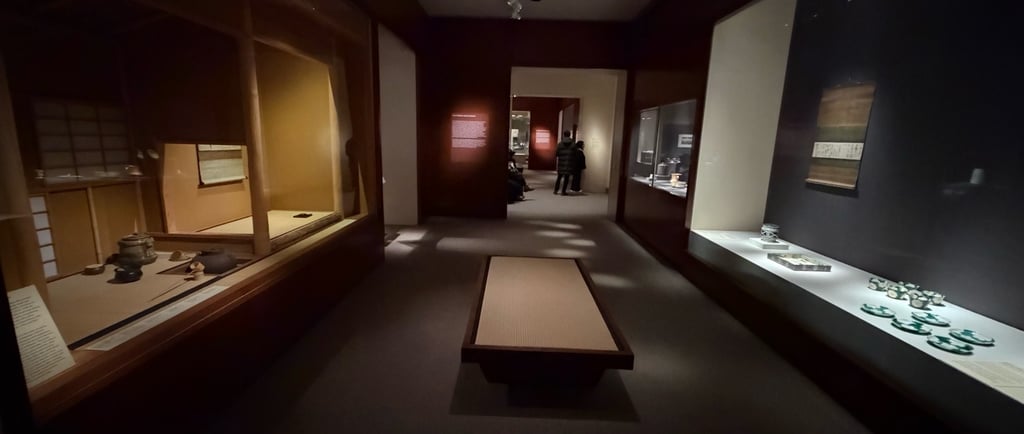
Gallery 228 in the Metropolitan Museum of Art is organized around a tea gathering room (chashitsu) installed behind glass. The space reads as a corridor with a stable left–right structure. On one side, the tea room forms an architectural anchor. While on the opposite side, vitrines present tea-related objects in small groupings. Rather than as a set of independent objects, this design frames tea culture as an organized practice—built space, heat and water management, and controlled display
SOCIAL
Ryan Cheng
5/15/20264 min read
Spatial Arrangement and Viewing Rhythm
Through sightlines and pacing, the gallery establishes a viewing sequence. Appearing as a
complete interior volume legible from a distance, the tea room tends to register before
extended wall text, while farther down the corridor near the next threshold sit larger text
panels. Placed along the central axis, a bench provides a planned pause point that supports
two modes of looking: close-range viewing to read labels and examine surfaces, and mid-
distance viewing to compare the tea room against the vitrines across the corridor.
A repeated alternation, not a single fixed route, is the result. Stepping toward the tea room, the viewer turns to the vitrines, then steps back to compare both sides. Not incidental in this room, movement is part of how the installation asks the viewer to assemble meaning from spatial relationships.
Glass as an Active Display Element
Visually, the glass barrier is not neutral. My own reflection repeatedly appears on the glass in my photographs. This makes the physical barrier visible. It also makes me shift sideways to reduce the glare. The viewer's face, phone, or outline appears over the tea room and the objects behind the glass.
The gallery's spotlights hit the glass at sharp angles. This creates narrow, bright reflections. These bright spots briefly hide faint details inside the room. I often stand close to read the labels. At this distance, my reflected phone screen and face become the sharpest shapes in view. They visually compete with the dim interior surfaces.
At certain spots, my silhouette lines up with the tatami grid and the utensils. This hides edges and flattens the sense of depth. I must step sideways to see the interior shapes clearly and reduce the glare. This effect changes the viewer's behavior. The viewer must find an angle with fewer reflections to see clearly. This forces them to move, lean, step sideways, or back up.
For interpretation, that micro-mobility matters. Actively staging distance and controlled access, the glass does more than simply protect the tea room. Although able to look into a space designed for invited participants, the visitor cannot enter it; by constantly returning the viewer's own body to the image, the reflection makes that restriction perceptible. Reinforcing the tea room's social logic, the display technology ensures that perception is mediated by thresholds and the gathering is carefully bounded.
The Chashitsu as Curatorial Template (tokonoma, materials, season)
Explaining that subdued materials and filtered light are used by tea rooms to create a setting of concentrated attention, the Met's interpretive text identifies the tokonoma alcove as the most important display zone for selected objects and a hanging scroll. Seasonal procedure is described as well: contrasting the sunken hearth (ro) used between November and early May against the portable brazier (furo) used between May and October. Becoming the gallery's logic, this internal logic operates in Gallery 228. Making the vitrines feel procedural rather than simply decorative, the tea room remains the interpretive anchor, while objects are lit and spaced to read as chosen components of a sequence.
Object Cluster 1: Heat + water (kettle and two mizusashi)
Because its dark mass becomes the vitrine's visual anchor, my focus is on the tea kettle (kama). With a granular surface, thick rim, and fitted lid, it sits as a compact, round cast-iron volume. Framing it as inherited craft rather than a single artwork, the label links it to specialized maker lineages for tea schools.
Making water legible through proportion and surface, two mizusashi sit across the corridor. Consistent with an imported form later adapted for tea, the Nanban jar (attributed to Nonomura Ninsei) features a squat stoneware body with oversized loop handles, where ash glaze thins and pools into mottled grays and browns. Wrapped in evenly spaced underglaze-cobalt bands tied to specific furo-season settings, the tall hoso-mizusashi (Hizen/Arita) stands in contrast as a glossy white porcelain piece.
Reading as an operating set, the kama and mizusashi together represent heat, water, and seasonal procedure. While registering a juxtaposition of polished, regulated finish against rustic, light-absorbing surfaces, the viewer can mentally place these utensils into a sequence because the glassed-in chashitsu (muted walls, tatami grid) remains visible across the corridor.
Object Cluster 2: Tokonoma + Atmosphere (Rikyū letter and kōgō)
Translating the tokonoma’s hierarchy described in the guide into two media—ink on paper and lacquered wood—the Rikyū letter and kōgō are highlighted here. Arranged in irregular columns, the "letter about sake" appears as brush-written calligraphy where strokes thicken and taper, shifting from saturated ink to dry breaks; the sheet is mounted as a hanging scroll with a framed border and bottom roller. Punctuated by iron-and-silver clamps, the nearby small round kōgō, signed, possesses a sealed lacquer sheen over wood grain. An atmosphere of scent and duration that the gallery cannot physically activate, along with social exchange (invitation), is cued by these materials.
Conclusion
A spatial mechanism serves as Gallery 228’s most salient feature: anchoring the viewer’s attention is a tea room behind glass, while procedural components are provided by vitrines across the corridor. Slowing viewing and making movement necessary are the bench, corridor pacing, and especially the reflective glass. Evidence that access is mediated and that perception is constructed through thresholds emerges from reflection and superimposition. Adapting tea-room discipline into exhibition design is achieved by the installation through these means. Rather than through rapid scanning or isolated appreciation, the viewer is trained to assemble meaning through sequence—moving from room to objects and back again.