Use Desktop for Better Experience
Visual Analysis of a Late Sixth-Century Chinese Glazed Jar
The Metropolitan Museum of Art, object no. 1996.15
SOCIAL
Ryan Cheng, Ashley Kan
4/28/20264 min read
Introduction
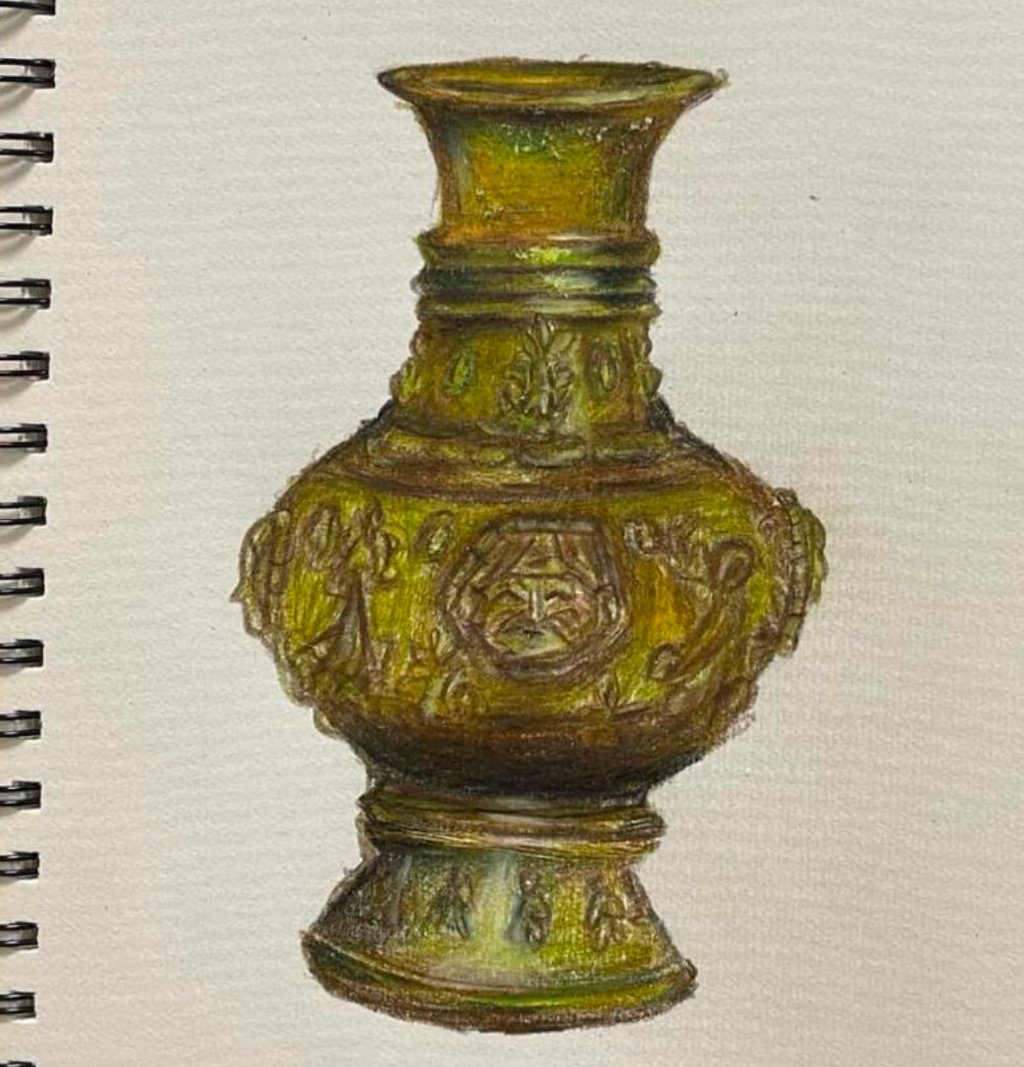
This paper analyzes a Chinese glazed ceramic jar dated the end of the sixth century (Northern Qi dynasty 550-577), which is now on display at The Metropolitan Museum of Art, Fifth Avenue, Gallery 205. The jar presents a symmetrical profile, including flaring mouth, elongated neck, rounded body, and splayed foot. It is also decorated with molded relief arranged in horizontal registers. This analysis begins with visible features of shape, surface, viewing experience, and then offers the brief iconographic identification.
Form and Silhouette (volume, proportion, axis)
The jar can be read as a vertical structure composed of distinct zones: the mouth, neck, shoulder/body, and foot. At the top, the mouth flares outward so as to form a wide rim with a thickened lip. This establishes a strong horizontal edge. Beneath it, the neck rises tall and narrow. This creates a transition between the open mouth and the jar’s widest volume below. Horizontal ridges encircle the lower neck; they interrupt the smooth contour and emphasize rotation and regularity. The shoulder then slopes outward into a bulbous body. It swells to its maximum diameter at the belly, where the jar’s visual weight is concentrated. Below, the profile tightens sharply before expanding into a high and flaring foot.
The foot functions as a pedestal. It lifts the rounded body and echoes the rim’s outward flare, creating a visual bracket at top and bottom. This repetition helps stabilize the silhouette. As a result, the jar feels firmly grounded while still extending upward along a clear central axis.
Glaze and Optical Effects (color, value, sheen)
The glaze appears glossy and translucent. It reads overall as olive-green but shifting through yellow-green, amber and brown. Due to the highly textured surface, the colour depends on relief. In places where the glaze thins over raised areas - rim edge, neck ridges, and projecting ornament, it appears lighter and more yellow-green, allowing the ceramic body to show through. In recesses, where it gathers between beads and inside grooves, it deepens to amber-brown. In this way, built-in value contrast is produced, which makes the relief legible without added pigments. Strong highlights collect along the rim and shoulder and break into smaller reflections across the beaded borders and raised motifs. Darker pooled glaze in recesses reads as shadow, so the jar’s color appears mottled and variable rather than uniform. Subtle streaking and uneven transitions suggest the glaze flowed during firing, thinning and collecting, according to gravity and topography.
Relief Decoration and Register System (line, rhythm, density)
Decoration is organized into horizontal bands that wrap around the jar and clarify each section of the form. The densest register occupies the belly: a continuous frieze of large circular medallions framed by pearl-like beading. Each bead reads as a small raised sphere; together they form a dotted ring whose repeated highlights create a crisp boundary. The museum label notes that four pearl roundels repeat around the circumference.
Within each medallion is a frontal head in molded relief. The face is stylized with rounded cheeks, heavy-lidded eyes, and a broad nose. Instead of being pursed, the mouth is set in a wide, upturned grin, revealing a glimpse of teeth. There is a distinct, handlebar-style mustache above the upper lip, which curls upward. The face is framed by stylized, striated hair along the top and sides. The face is enclosed within an outer ring of raised beads.
Between the medallions, mirrored scroll forms curve outward and back in. This creates pronounced “S” and “C” movements that contrast with the medallions’ circular geometry. Smaller palmette-like motifs fill remaining spaces, increasing density and texture. These repeated units establish rhythm together: stable roundels punctuated by scrolling, projecting relief.
The shoulder above the belly carries a secondary band of smaller applied motifs, such as repeating oval bosses and more complex pendant forms that visually hang downward. The band softens the transition between neck and body. The foot supports another register of downward-pointing lappets marked with central ridges, reinforcing weight and grounding at the base. The jar has repeated pattern in each zone and these: neck rings, belly roundels/scrolls, foot lappets. Hence, the jar reads as a stacked system of bands.
Technique and Viewing Experience (process and movement)
The jar’s symmetry and continuous curvature suggest wheel-throwing for the basic form. The crisp repetition of beading, medallion frames, bosses, and lappets suggests that molded appliqué was added before glazing and firing.
The decoration encourages movement. A frontal head can be fully centered only from one angle at a time, prompting the viewer to circulate around the jar to encounter the repeating medallions. At the same time, the object prompts vertical scanning: the eye moves from the reflective rim down the neck rings, across the dense belly frieze, and finally to the foot lappets.
Brief Iconography (identification, not interpretation)
Although the focus remains formal, limited identification helps name repeated motifs. The museum label describes the heads as “Central Asian” faces framed by pearl roundels and notes that comparable frontal heads within pearl beading occur in early Central Asian art, including Khotanese earthenwares. The label also associates parts of the decorative program with Buddhist visual conventions (for example, elongated earlobes and certain ornamental forms).
Conclusion
This late sixth-century jar is defined by the interaction of a stable silhouette and an active surface. The flaring mouth and splayed foot bracket a rounded belly, producing a balanced, axial structure. Horizontal registers organize the surface into readable zones, while repeated appliqué motifs create rhythm and prompt the viewer to move around the jar. The glossy green glaze unifies the jar but shifts in value as it thins on high points and pools in recesses, modeling relief through light and dark. The result is an object that reads clearly in outline from a distance and becomes more legible at close range through dense, tactile detail.